
Why Reef pH Runs Low in Oklahoma City Homes
If your reef tank's pH sits stubbornly low, your alkalinity and calcium test fine, and you have checked every obvious cause without finding an answer, the source of the problem might not be in the tank at all. It might be the air in the room.
Last verified
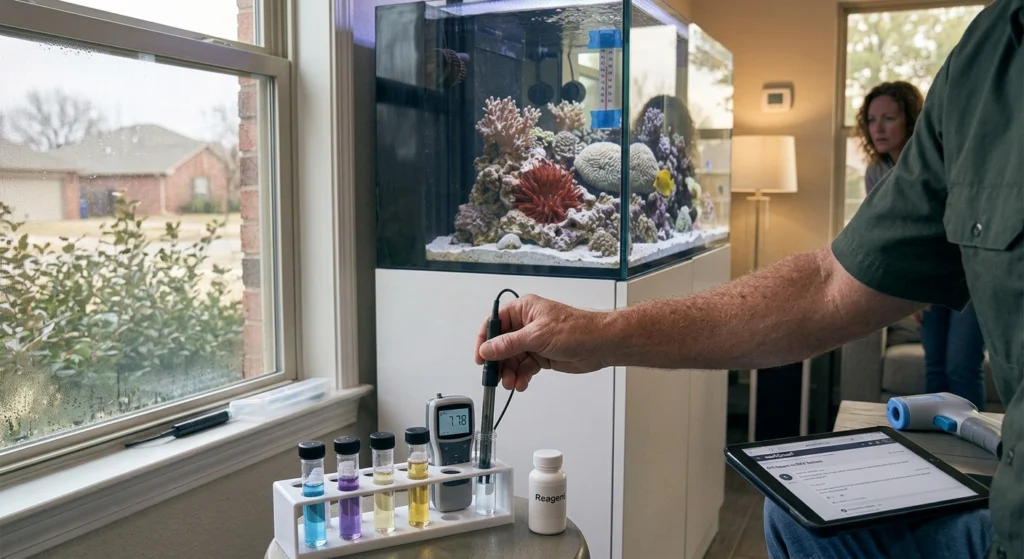
Oklahoma City homes are well set up for this pattern, and it has a specific, well understood cause.
The mechanism, briefly
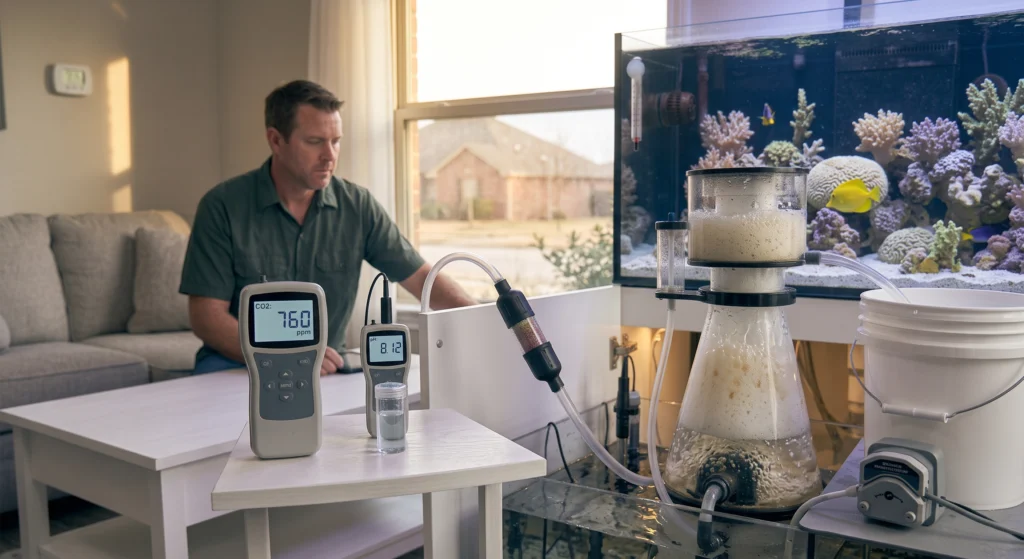
Reef tank pH is heavily influenced by dissolved carbon dioxide in the water, and dissolved CO2 in the water is heavily influenced by CO2 in the surrounding air. A protein skimmer continuously pulls room air through the water column, which means your tank’s water is, in a very direct sense, in constant chemical conversation with whatever air is in that room.
Most homes have indoor CO2 levels somewhat above outdoor ambient simply from people breathing, but a house that is tightly sealed and rarely opens its windows can build up meaningfully higher indoor CO2 than a house that gets regular fresh air exchange. Higher indoor CO2 pushes more CO2 into the tank water, and more dissolved CO2 lowers pH, independent of alkalinity or calcium.
That is the whole mechanism. Nothing exotic, and nothing wrong with the tank itself.
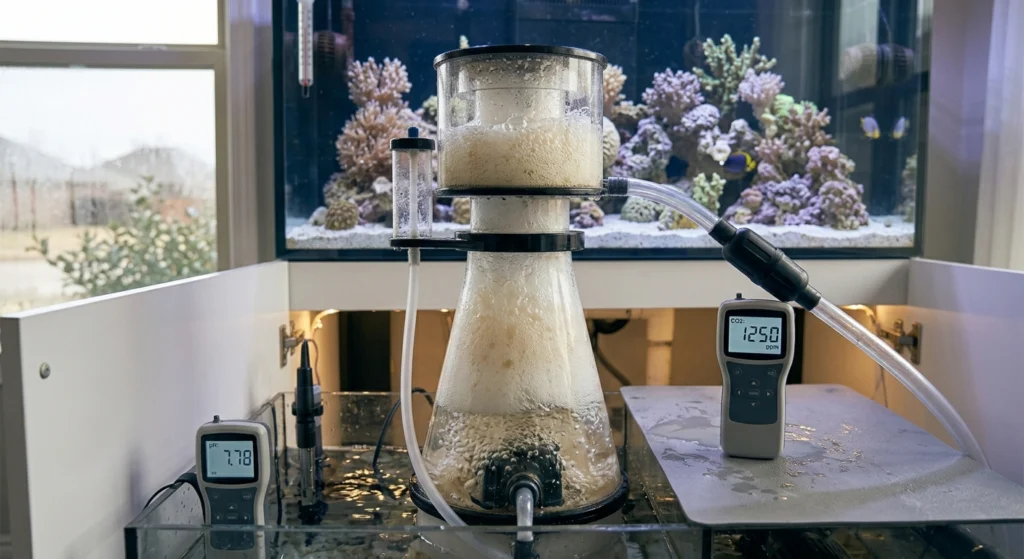
Why Oklahoma City homes are well set up for this
Oklahoma City homes are well set up for this pattern because they can remain closed and conditioned for long stretches during both summer and winter. Summers run hot enough, for long enough, that air conditioning runs for months at a stretch, and winters bring genuine cold that keeps the furnace running for another few months on top of that. Between the two seasons, a house here can spend extended periods sealed up and mechanically conditioned rather than exchanging air with the outdoors.
That pattern, long stretches of a sealed, conditioned house across both a real cooling season and a real heating season, is exactly the condition that lets indoor CO2 build up above what a home with more mild, moderate weather might typically see. It is not that Oklahoma City air is somehow different. It is that Oklahoma City’s climate gives a house two separate long seasons where staying sealed up and conditioned is simply the practical way to live in it.
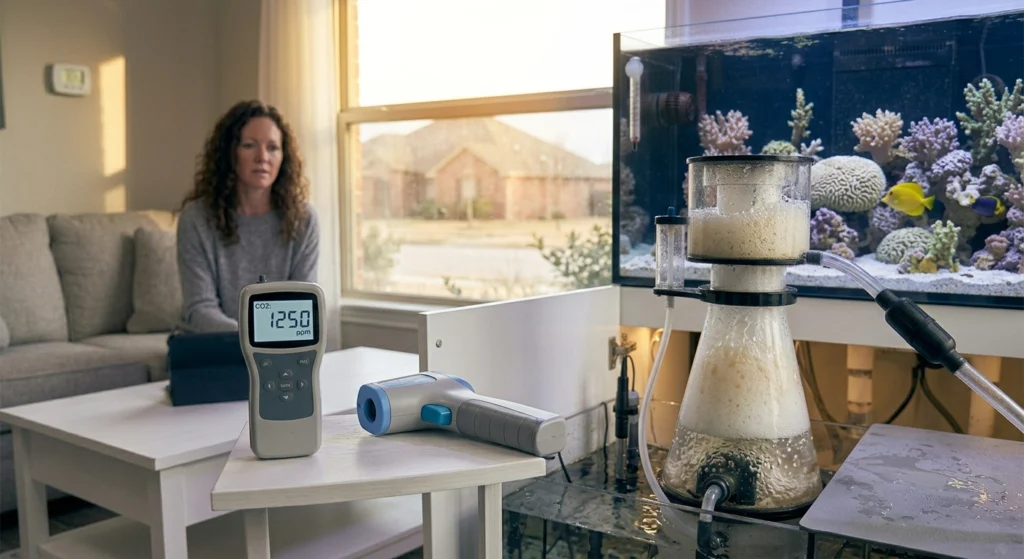
How to tell if this is actually your situation
The clearest signature is a pH reading that sits low while alkalinity and calcium both test within a normal, stable range. If your dosing is consistent and your alkalinity is not swinging, but pH still reads lower than you would expect, this mechanism is a strong candidate.
A useful, if informal, way to test the theory is to watch whether pH tends to read lowest in the evening, when a house has typically been closed up and occupied the longest with no air exchange, and somewhat improved after a period when a door or window has been open, weather permitting. That pattern, if you see it, is a fairly direct confirmation.
It is also worth noting when the pattern tends to be worst. Homes here are most likely to be fully sealed during the depths of summer and the coldest stretches of winter, the two periods when running the HVAC system continuously makes the most sense and opening a window makes the least. If your pH has a seasonal quality to it, worse in July and January than in a mild April, that lines up with this mechanism rather than a chemistry problem.
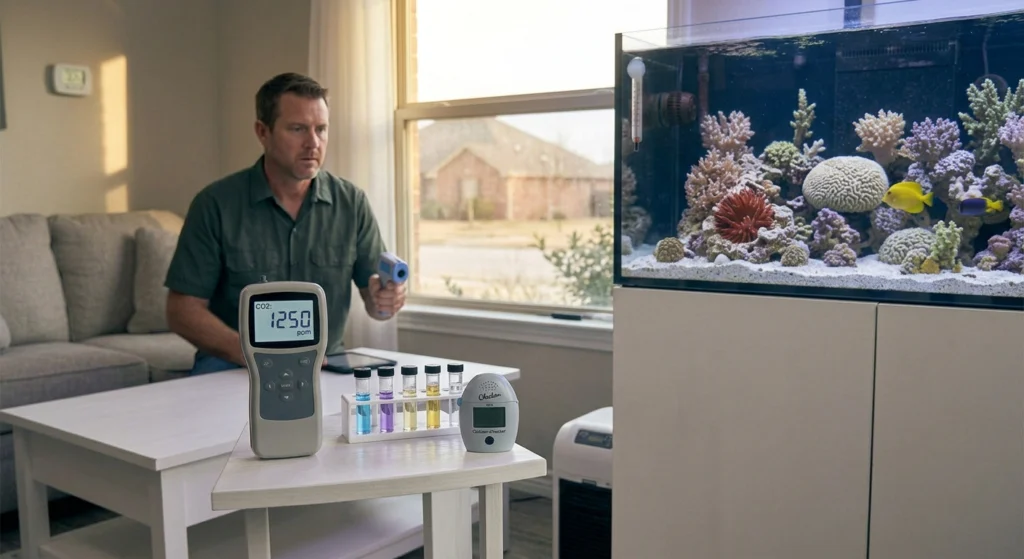
What actually helps
The most direct fix is more fresh air exchange in the room, which is not always practical given the reason the house was sealed up in the first place. A few more workable options exist.
Running your protein skimmer’s air intake from outside the house rather than pulling from indoor room air is one of the more effective fixes, since it removes the skimmer from the indoor CO2 loop entirely. This does mean routing a length of airline tubing to an exterior wall or vent, which is a reasonable project for most equipment room setups.
A CO2 scrubber on the skimmer intake accomplishes something similar without needing to route air from outside, by stripping CO2 out of the air before it reaches the skimmer.
Kalkwasser dosing through an auto top off system raises pH directly as part of replacing evaporated water, and it is a commonly used tool specifically for reef systems that run persistently on the low side. It is not a universal fix for every low pH situation, since it addresses the symptom rather than the room’s air exchange, but for a tank affected by this specific mechanism it is a genuinely effective one.
One important caveat worth flagging directly: during a wildfire smoke event or a period when local air quality guidance recommends keeping windows closed and running HVAC on recirculate, routing a skimmer’s air intake outside is not a good idea, since it would draw in whatever is in that outdoor air along with everything else. The right response during those specific stretches is closer to running extra carbon in the tank and accepting a temporary pH dip, rather than opening up the skimmer’s air path. This is a genuine, if occasional, exception worth knowing about rather than a reason to avoid the outside air fix generally.
Reef pH: causes of low pH and what actually fixes it covers the full range of causes beyond this one, for anyone whose situation does not match this specific pattern.
If you have chased a low pH reading for a while without a clear answer, this is exactly the kind of thing worth having looked at directly rather than guessing further on your own, and it is a common enough starting point in a reef maintenance visit in this market.
Sources
- National Weather Service, Norman Forecast Office Oklahoma Climate Normals, accessed September 2026
- Oklahoma Department of Environmental Quality Air Quality Advisories, accessed September 2026