Reefkeeping in Oklahoma City: What's Actually Different Here
Last verified

Most reef aquarium advice is written by someone who has never seen your water, your weather, or your house. That’s not a knock on the advice, a lot of it is good. But “good in general” and “correct for your address” aren’t the same thing, and in Oklahoma City the gap between them is bigger than most reefkeepers realize.
We’ve kept and serviced reef systems in this metro for a long time, and the same handful of local conditions show up again and again, in the questions people ask, in the tanks we get called out to fix, and in the small adjustments that separate a system that runs itself from one that fights you every month. None of this is exotic. It’s water, weather, electricity, and the way houses get built here. But each one bends the standard reefkeeping playbook slightly, and if nobody tells you where, you end up debugging your tank when the real answer was upstream of it.
This page is the short version of all of that. Think of it as a map. Each section below covers one condition at the level you actually need, then points to a deeper page if you want the full explanation.
Your water depends on where you live
Oklahoma City doesn’t have one water supply, it runs two treatment plants drawing from different sources roughly 250 miles apart, and the surrounding cities in the metro largely run their own systems on top of that. That matters for a reef tank because your RO/DI unit is only as good as what it’s fed, and “Oklahoma City water” isn’t a single, fixed thing to design around.
Where Oklahoma City’s water actually comes fromThe city disinfects with chloramine rather than plain chlorine, which changes what your pretreatment needs to do before water reaches a membrane.
why chloramine matters more here than in a lot of marketsAnd because feedwater varies, so does how hard your RO/DI has to work and how often it needs attention, which is a different question from what’s in the water in the first place.
running an RO/DI system hereIf you live in Edmond, Nichols Hills, The Village, or Piedmont, your water situation may look nothing like Oklahoma City’s, sometimes it’s genuinely different, and sometimes it’s closer than people assume.
how source water compares across the metro
Summer here is long, and it’s not just about air temperature
Oklahoma City summers run hot for months at a time, with stretches of high heat and high humidity that push home air conditioning hard. For a reef tank, the real story usually isn’t the peak temperature, it’s how much your AC has to fight to hold a setpoint, and what happens on the days it can’t quite keep up. A tank that’s rock steady in April can start drifting warm by August for reasons that have nothing to do with the aquarium itself: an AC system working at reduced capacity, a thermostat setback during the hottest part of the afternoon, or a room that simply runs warmer than the rest of the house.
Oklahoma summers also mean real thunderstorm activity and, some years, extended dry stretches, both of which show up in a reef tank as evaporation swings, salinity drift, and heavier demand on auto top-off systems than a spec sheet would suggest.

Winter brings a different problem: the power
Oklahoma City gets genuine winter weather, including ice storms that have knocked out power across the metro for days at a time rather than hours. That’s the detail that matters most for a reef aquarium here: most power-outage advice online is written around a worst case of “a few hours,” and in this market the honest worst case is longer than that.
how to actually plan for outages hereIf you keep a reef in this metro, backup power and a plan for extended outages aren’t optional extras, they’re closer to standard equipment.

The air inside your own house affects your tank’s pH
This one surprises people. Oklahoma City spends a good part of the year with windows closed, hot enough to run air conditioning for months, then cold enough to run heat for another few. A tightly sealed, well-conditioned house is great for your energy bill and can be quietly rough on reef pH, because indoor CO2 levels rise in a closed-up home and that CO2 exchanges into your tank water.
If you’ve chased a low, stubborn pH reading and everything else checks out, alkalinity’s fine, salinity’s fine, nothing’s obviously wrong, the house itself is worth a look before you assume it’s a dosing problem.
why reef pH runs low in Oklahoma City homes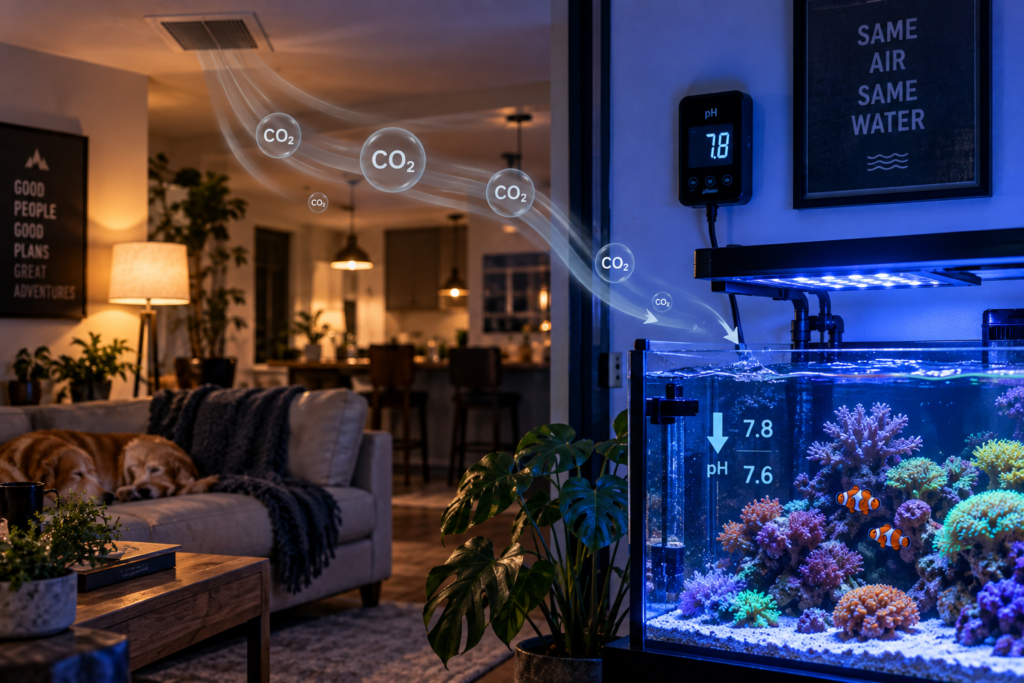
Most homes here don’t have basements, and that changes where your equipment lives
Slab-on-grade construction is the norm across the metro, which means the classic “put the sump in the basement” advice simply doesn’t apply to most Oklahoma City homes. Equipment ends up in a garage, a closet, or a dedicated room instead, and each of those locations comes with its own temperature swings, humidity behavior, and access considerations that a basement wouldn’t have.
where OKC reefkeepers actually put their equipmentIf you’re planning a new system or moving an existing one, this is worth thinking through before equipment gets plumbed in, not after.
Our approach to reef aquarium design and installation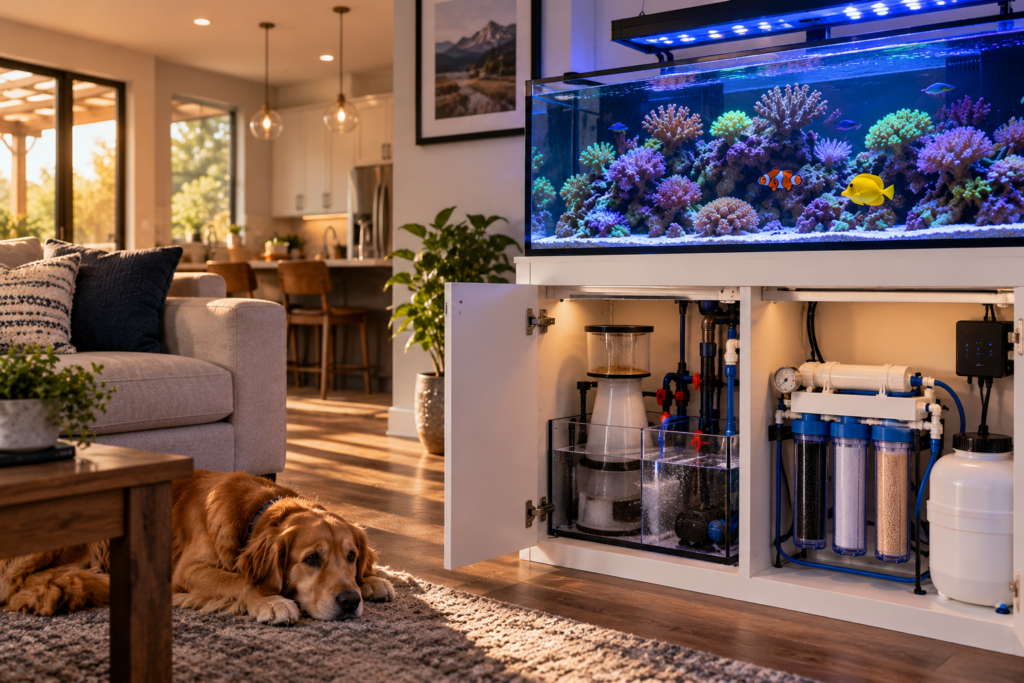
A few environmental things worth knowing
Oklahoma City runs a long mosquito season, and both municipal spraying and residential pest control treatments are common through the warmer months. Reef tanks pull room air through protein skimmers continuously, and airborne chemical exposure near an equipment space is a real, if under-discussed, risk to livestock, particularly invertebrates.
what to know about pest control near a reef tankSevere spring storms are part of life here too, and beyond the obvious safety concerns, they’re worth having a plan for if you ever need to protect or relocate a system quickly.

Where to go from here
None of this means Oklahoma City is a hard place to keep a reef. It’s a very doable one, thousands of people here run beautiful systems for years without drama. It just means the standard advice needs a few local corrections, and now you know what they are. Start with whichever section above matches whatever’s actually bothering you right now, and work outward from there.
If you’d rather have someone look at your specific system, room, and address instead of piecing it together yourself, that’s exactly what a reef assessment is for.
Request a reef assessmentSources
- City of Oklahoma City, Utilities Department "About Your Tap Water" and Drinking Water Quality Report pages — supports the two-treatment-plant structure and chloramine disinfection referenced in the water section.
- National Weather Service, Norman Forecast Office Oklahoma City climate summaries — supports general seasonal heat, humidity, storm, and ice-event characterizations.
All Reef Guides
Reefkeeping in Oklahoma City
Reef Source Water by City: How the Oklahoma City Metro Compares
How water sources compare across Oklahoma City, Edmond, Nichols Hills, The Village, and Piedmont — and why your address matters more than…
Running an RO/DI System in Oklahoma City
What Oklahoma City reefkeepers should know about RO/DI performance, service timing, and local feedwater — a practical framework, not a fixed schedule.
Oklahoma City Tap Water and Your Reef Aquarium
Where Oklahoma City's tap water comes from, how it's treated, and why that matters for your reef aquarium's RO/DI system. A local…
Chloramine and Your Reef Aquarium in Oklahoma City
Yes, Oklahoma City disinfects with chloramine. Here's what that means for your reef aquarium, your RO/DI system, and why a 0 TDS…
Reef Aquariums Through an Oklahoma City Summer
Oklahoma City summers run hot for months, and the real risk to a reef tank usually is not the peak temperature. Here…
Reef Aquariums and Oklahoma City Power Outages
Oklahoma City outages can last days, not hours. Here is how to actually plan a reef aquarium backup strategy for this market,…
Reef Maintenance
Reef Aquarium Equipment: How It Works and How It Fails
An overview of the equipment that runs a reef tank, what each piece actually does, and where the common failure points are.
Reef Aquarium Water Chemistry: The Complete Guide
An overview of the parameters that actually matter in a reef tank, how they relate to each other, and where to go…
Reef Problems and Recovery
Reef Recovery After a Power Outage
Power is back, but your reef tank might not be in the clear yet. Here is what to check first after an…
Design and Installation
Backup Power for Reef Aquariums
A battery pack and a whole home generator solve different problems. Here is how to actually plan backup power for a reef…
Commercial Reef Aquariums
Office Reef Aquariums
A reef aquarium in an office lobby faces different conditions than one in a home. Here is what a business should know…