
Mosquito Spraying, Pest Control, and Your Reef Tank
A protein skimmer runs constantly, and it works by pulling large volumes of room air through the water column. That is normally just background mechanics. During mosquito or pest control season, it becomes something worth thinking about directly, because it means your tank's air intake and your yard's pest treatment schedule are more connected than most reefkeepers realize.
Last verified
Why this matters specifically in Oklahoma City
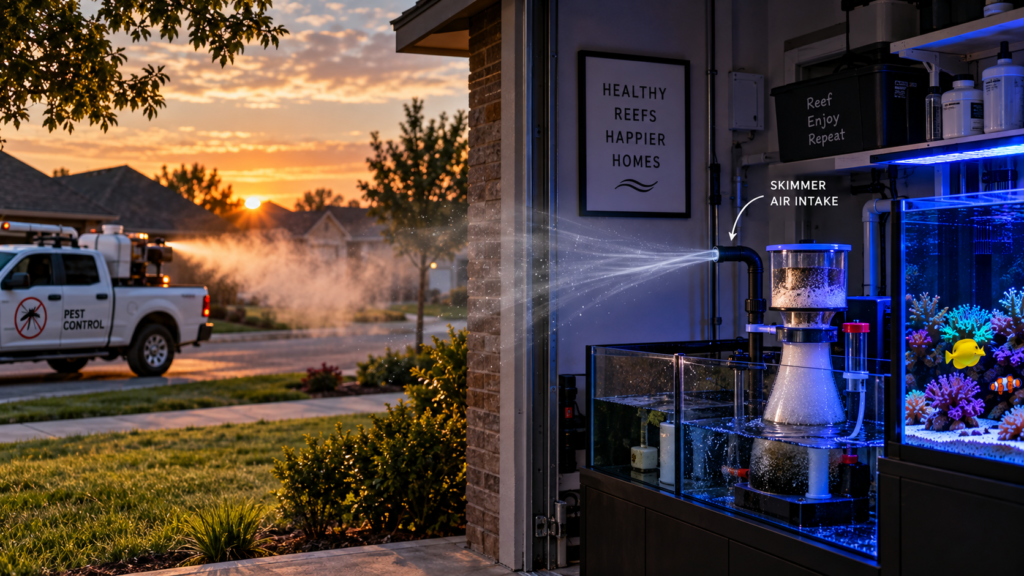
Oklahoma City runs mosquito season roughly from May through November, and the Oklahoma City County Health Department promotes mosquito borne disease prevention through that stretch as part of managing West Nile virus risk. Insecticide spraying, whether through a public health program or a private pest control company, is one of the control methods used in this area, alongside the more visible personal precautions like repellent and draining standing water that the health department emphasizes directly to residents. Residential pest control companies commonly offer monthly perimeter treatments through the warmer months as well, treating the exterior of homes against mosquitoes and other pests, and that private, residential layer is the more consistently documented source of spraying near an actual home.
Both of these are entirely normal, unremarkable parts of living in this climate. Neither is something to be alarmed about. But both involve airborne or surface applied insecticides, and the active ingredients most commonly used in mosquito control, a class of compounds called pyrethroids, are known to be highly toxic to aquatic invertebrates at very low concentrations, far lower than what would concern a mammal.
That combination, a continuously running air intake and a seasonal insecticide application nearby, is worth understanding even though a confirmed case of it causing harm to a specific reef tank has not been documented in a way this article can point to directly. The mechanism is real and well established even where the outcome has not been specifically tracked.
It is worth being precise about what is and is not being claimed here. The toxicity of pyrethroid compounds to aquatic invertebrates is well established in general aquatic toxicology, not a reef specific finding, and the concentrations involved in a typical residential or municipal application are generally intended to break down quickly in the environment. This is a plausible, mechanistically sound risk worth taking sensible precautions against, not a documented epidemic of reef tank losses tied to pest control in this specific market.

The realistic exposure pathways
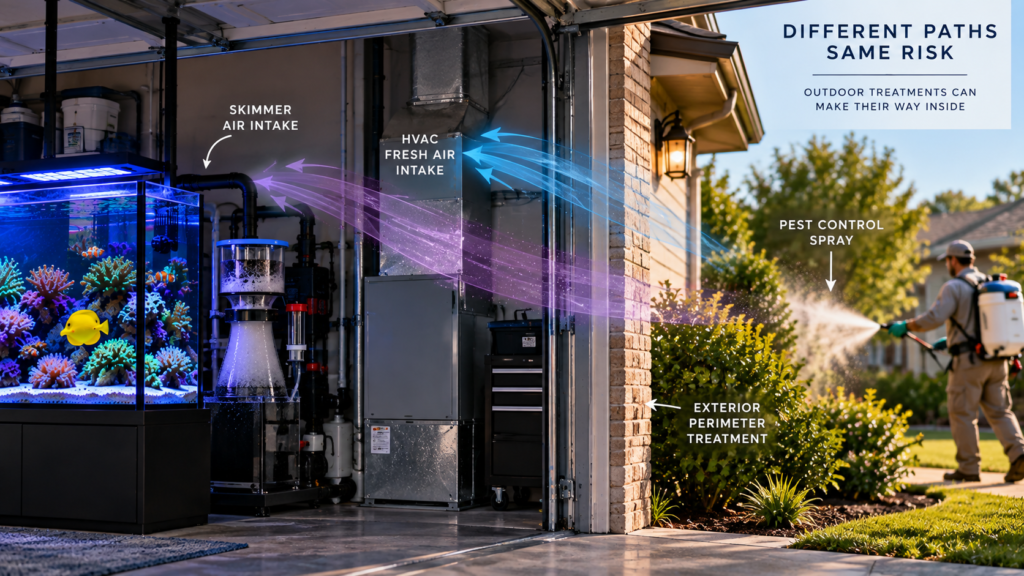
Residential perimeter pest treatments are the more direct and better documented concern for a reef tank, particularly if the equipment space itself, commonly a garage in this climate given how few Oklahoma City area homes have basements, shares a wall or airflow with a treated exterior surface. A garage door left open during or shortly after a perimeter treatment, with a skimmer’s air intake pulling from that same garage air, is a realistic path for something to reach the tank.
Where municipal or area wide adulticide spraying is used as a control method, it typically happens after sunset and, where trucks are involved, drifts through a neighborhood rather than targeting a specific yard. A window left open on a treatment night, or an HVAC fresh air intake positioned where drifting spray can reach it, would be the exposure route in that scenario, though the residential, perimeter treatment pathway above is the one with clearer local support.
Reef equipment rooms in houses without basements goes further into why garages often become a practical equipment space in this market and what that means for a few other local conditions as well.
The same logic extends to HVAC fresh air intakes on the house itself, not just the aquarium’s own equipment. If your home’s air handling system pulls any outside air directly, and many do to some degree, that intake deserves the same seasonal awareness as a skimmer’s air line, since it feeds the whole house’s air rather than just one room.
What a sudden, selective loss can look like
If you ever see a sudden, unexplained loss concentrated in invertebrates, shrimp, crabs, and snails affected while fish in the same tank seem comparatively unaffected, that pattern is consistent with a pyrethroid class exposure, since these compounds are dramatically more toxic to crustaceans and other invertebrates than to fish. It is not the only possible cause of that pattern, but it is worth considering, and worth asking a simple, direct question: was anything sprayed nearby recently.
Sudden invertebrate loss: shrimp, crabs, and snails covers this diagnostic picture in more depth alongside the other common causes of the same symptom.

Practical steps that cost nothing
A few habits meaningfully reduce the realistic risk without requiring any equipment changes.
Know your own pest control schedule, whether that is a municipal spraying notification or a residential service’s regular visit date, and treat that day and the evening after it as a reason for a little extra caution around the tank’s air intake.
If your equipment room shares airflow with an area being treated, close that connection, a garage door, a shared vent, during and immediately after treatment, and let some time pass before reopening it.
If you use a residential pest control company, it is entirely reasonable to ask them not to treat directly against an exterior wall that backs onto your equipment room, or to avoid spraying inside a garage that houses aquarium equipment. Most companies can accommodate a request like that without it affecting the rest of the treatment.
Running fresh activated carbon in the system around a known treatment date is a reasonable, low effort precaution, since carbon is effective at adsorbing a range of organic compounds from water, including some pesticide residues, even though it is not a guaranteed defense against every possible exposure route.
If something does go wrong
An unexplained, invertebrate heavy loss following a known treatment nearby is exactly the kind of situation where a proper diagnostic visit is more useful than guessing at home, since ruling out the other common causes matters as much as confirming the likely one. That kind of investigation is core Reef Recovery work.

Sources
- Oklahoma City County Health Department Fight the Bite, accessed September 2026
- National Pesticide Information Center, Oregon State University Pyrethroids and Pyrethrins, accessed September 2026