
Reef Aquariums Through an Oklahoma City Summer
Last verified
An Oklahoma City summer is long, humid, and hard on home air conditioning for months at a stretch. For a reef aquarium, the temperature on the hottest day of the year is rarely the real problem. The problem is what happens on an ordinary hot week when the house’s cooling system is already working near its limit, and the tank has nowhere left to shed the heat it is picking up.
Why the room usually matters more than the outdoor temperature
A reef tank’s temperature is a function of its room, not the weather report. Two identical tanks in two different rooms of the same house can behave completely differently in July, because the room, not the forecast, is what the equipment is actually fighting.
Rooms that run warm in an Oklahoma City summer tend to share a few traits: west or south facing windows that let in direct afternoon sun, poor air circulation from the house’s main HVAC system, or a location far from the return air path so the room simply gets less conditioned air than the rest of the house. A living room with a big west window and a large display tank against that same wall is a common setup and a genuinely difficult one to keep cool in August.
Where to put a reef aquarium in an Oklahoma City home goes deeper into how to choose a location that does not fight the local climate before a tank is even built.
Evaporation and salinity move faster than people expect
Higher ambient temperature and, often, higher humidity during Oklahoma’s stormier summer stretches both affect how fast a tank evaporates, and not always in the direction people assume. Heat increases evaporation. Humidity slows it. Which effect wins on a given week depends on both, and the result is that a tank’s evaporation rate in July can be meaningfully different from its rate in April, even with nothing else changed.
An auto top off system sized comfortably for spring conditions can run through its reservoir noticeably faster in mid summer. If a reservoir has been running dry sooner than it used to, that is usually the explanation, not a sign that something has failed.
The bigger issue is what happens if evaporation outpaces the system’s ability to keep up, whether that is a reservoir running empty or a float switch sticking. Salinity that drifts upward over days is a slower, quieter stressor than a sudden temperature spike, but it is a real one, and it is more likely to happen during exactly this stretch of the year.
When cooling equipment becomes necessary, not optional
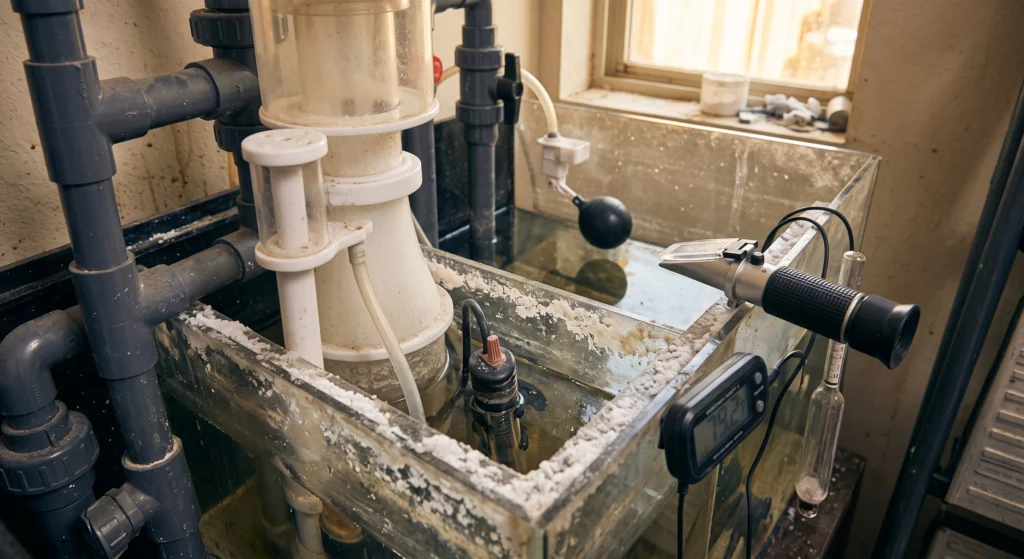
A fan blowing across the sump’s surface is often enough to hold a stable temperature through a normal Oklahoma summer in a well placed tank. It is not always enough in a room with real solar heat gain, a tight equipment space with poor airflow, or a house whose air conditioning is already working at its limit on the hottest days.
Reef chillers, when you need one and when you don’t covers how to tell which situation you are actually in rather than guessing.
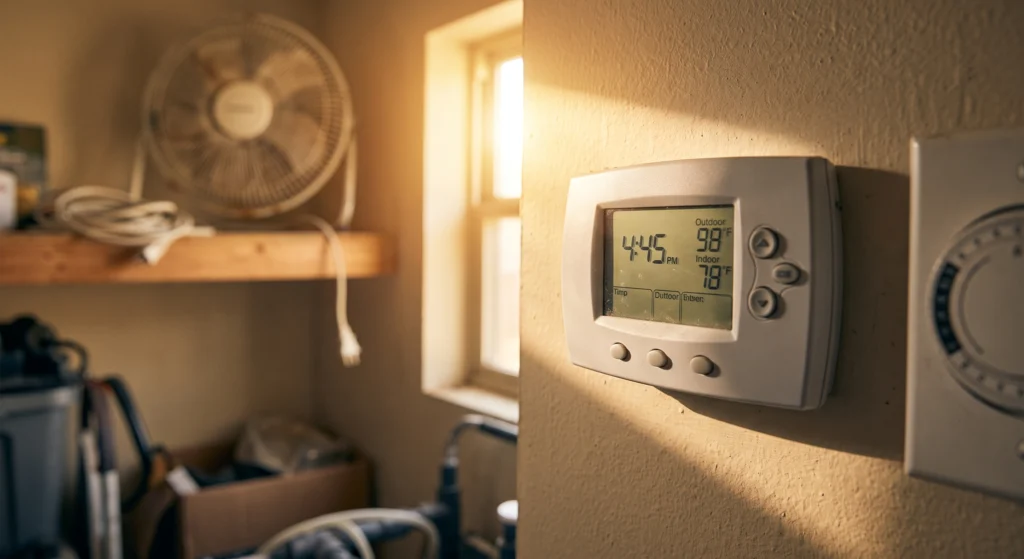
Thermostat behavior deserves its own mention here. A house that sets back its air conditioning during the afternoon, whether for cost reasons or simple habit, is setting back cooling during precisely the hours an Oklahoma City summer is hottest. OG&E SmartHours and your reef aquarium covers one specific version of this that is worth understanding if you are on that program.
What actually goes wrong, and when to worry
A tank running a degree or two above its normal range on a hot afternoon and settling back down overnight is a completely normal pattern in this climate and not, by itself, a reason for concern. Most reef livestock tolerates a gentle daily swing within a reasonable range without issue.
What is worth paying attention to is a tank that no longer settles back down overnight, one where the daily high keeps creeping upward week over week, or one that shows a sudden jump rather than a gradual drift. Those patterns usually point to something specific, a failing fan, a room that has gotten hotter for an external reason such as a broken AC unit, or a chiller that has stopped keeping up, and temperature instability in reef systems walks through how to work out which one you are looking at.
Coral bleaching from heat stress in a home aquarium is almost always the result of a sustained period at an elevated temperature, not a brief afternoon spike. That is genuinely useful to know, because it means there is usually time to catch and correct a slow drift before it becomes a livestock problem, provided something in the system, a controller, a thermometer you actually check, or a maintenance visit, is watching for it.
If you are heading into summer and want your cooling setup, room placement, and ATO capacity reviewed before the heat actually arrives, that kind of seasonal check is exactly what ongoing reef maintenance is built to catch.
Sources
- National Weather Service, Norman Forecast Office Oklahoma Climate Normals, accessed September 2026