
Reef Aquariums and Oklahoma City Power Outages
Most reef aquarium advice about power outages is written around a worst case of a few hours. In Oklahoma City, that assumption can get you into real trouble.
Last verified
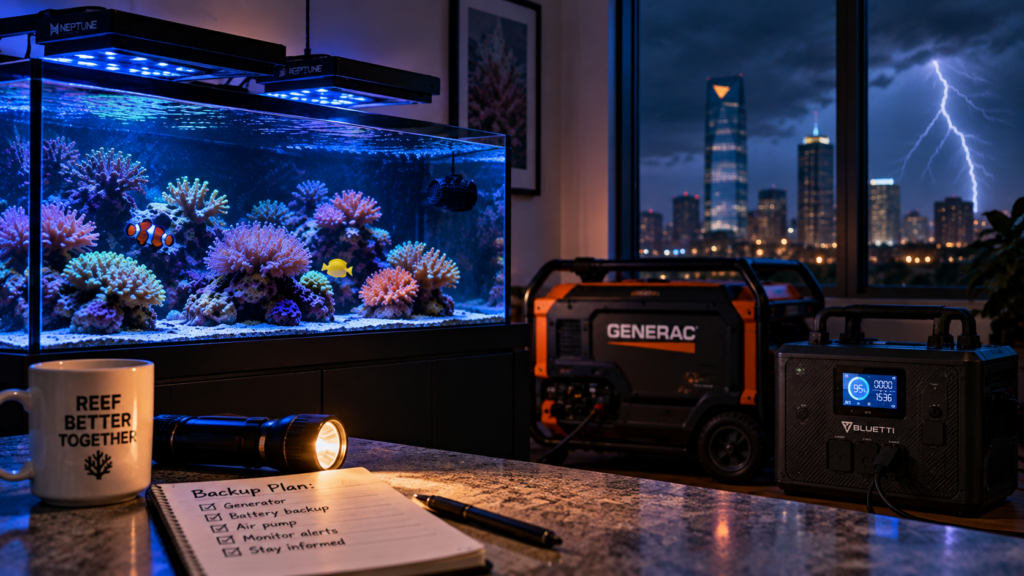
This metro has a documented history of multi day outages, not multi hour ones. If you keep a reef aquarium here, your backup plan needs to be built around that reality, not around the generic advice you will find on most national reefkeeping sites.
Here is what actually happens during an Oklahoma City outage, what kills a reef tank first, and how to build a plan that matches this climate instead of a milder one.
The realistic worst case here is measured in days
In late October 2020, an ice storm hit the Oklahoma City metro and knocked out power to more customers than any storm in OG&E’s history. At the peak of the outage, more than 445,000 OG&E customers, roughly 60 percent of the utility’s Oklahoma customer base, were without power. A week into the event, tens of thousands of homes in Oklahoma City alone were still dark. Full restoration took close to two weeks in the hardest hit areas.
That is not a freak event unlikely to repeat. Ice storms are a normal part of an Oklahoma City winter, and this metro sits in a part of the country where severe thunderstorms, high winds, and the occasional tornado can all take down power lines during the warmer months too.
The practical takeaway: a battery backup rated for two or three hours is genuinely useful for the outages that happen most often (brief storm related blips), but it is not a plan for the outage that will actually threaten your livestock. That plan needs to account for days, not hours.
Reefkeeping in Oklahoma City: what’s actually different here covers the rest of this metro’s local conditions if you have not read it yet.

What actually kills a reef tank during an outage, and when
The order of failure depends heavily on the season, and this is where a lot of generic advice gets it backwards.
Summer heat makes oxygen depletion especially urgent. Warm water holds less dissolved oxygen to begin with, biological demand for oxygen is already elevated because everything in the tank is running warmer, and once circulation stops there is nothing left to move fresh surface water past the livestock. A tank can move toward an oxygen crisis within a few hours of losing power on a hot day.
Winter outages add a second, progressively serious problem on top of that same oxygen concern: heat loss. Water holds heat longer than it holds dissolved oxygen, so a tank losing power in January tends to lose temperature more gradually than it loses oxygen, but that temperature loss becomes more serious the longer the outage runs, and an ice storm outage that stretches into days can eventually bring a tank down toward a cold, heatless room. Oxygenation still matters in a winter outage. It does not stop mattering just because temperature is the slower moving problem.
The exact progression, how fast oxygen becomes a concern, how fast temperature becomes a concern, depends on the specific system: how heavily it is stocked, how warm or cool the room already runs, how much surface agitation and residual circulation exist without power, and how long the outage actually lasts. This means your backup priorities should not be identical in every season, and they should not be reduced to a single fixed rule either. A plan of “run this battery pack no matter what” misses the point. What matters is understanding which failure mode is developing in your specific tank and responding to that.
Building a plan that matches this climate
A few components handle most of what an Oklahoma City reefkeeper actually needs, and they solve different problems.
Battery backed air and circulation covers the short, frequent outages, thunderstorm blips, momentary utility switching, brief line faults, that happen far more often than a major storm. A small battery air pump or a battery backed powerhead keeps oxygen moving and prevents stagnation during anything under a few hours, in any season.
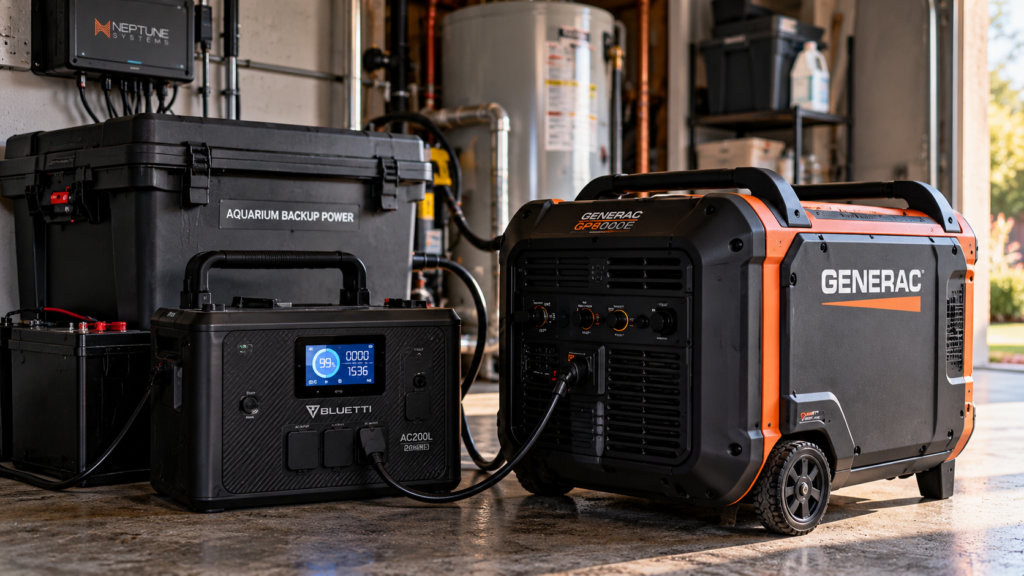
A generator, whether portable or a standby unit tied into the house, is what actually answers the multi day scenario this metro is known for. If you are considering a standby generator, backup power for reef aquariums goes into the specifics of sizing, transfer switches, and what to check before you assume a whole home generator automatically protects your tank.
A controller with remote alerting matters more here than in a market with gentler weather, simply because outages are more likely to happen while you are not standing in front of the tank. Knowing within minutes that power has dropped, rather than discovering it hours later, changes what you are able to do about it.
Restart behavior is the part almost nobody plans for. When power returns after an extended outage, every pump, heater, and doser in the system tries to restart at once, often on a circuit that is also restarting the house’s air conditioner, refrigerator, and water heater. A skimmer that has been off long enough to settle will frequently overflow the moment it restarts. Restart sequencing covers how to stage equipment back on in an order that avoids that mess, which matters more in a market where restarts are a real, recurring event rather than a rare inconvenience.
What to do the moment power goes out
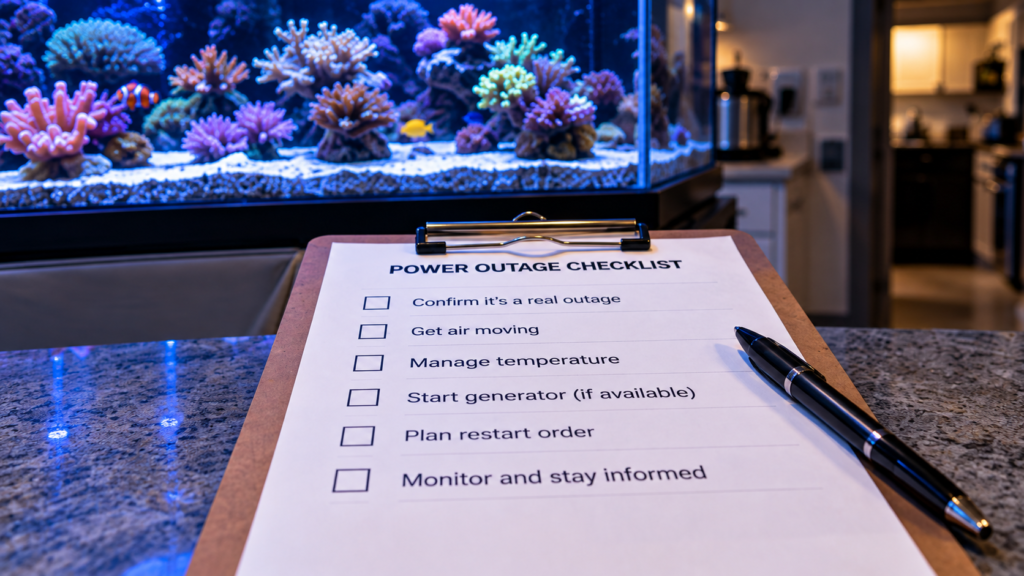
The right response depends on the season and how long you expect the outage to last, which you often will not know at the start. A reasonable general approach:
First, confirm it is a real outage and not a tripped breaker or a GFCI issue local to the tank’s circuit.
Second, get air moving by any means available. A battery air stone, a small battery powerhead, or even manually agitating the surface with a container of tank water poured back in from height will all buy time.
Third, insulate against temperature swings if the outage looks likely to run long. In summer that might mean opening the stand doors so ambient room air reaches the sump rather than trapping heat. In winter it means covering the display to slow heat loss and, if it is safe to do so, running a battery or propane heater in the room itself rather than trying to heat the tank water directly with no power.
Fourth, if you have a generator, get it running and think through restart order before you simply throw the main breaker back to the house circuit.
Fifth, if the outage is extending into the ice storm range, days rather than hours, prioritize keeping livestock alive over maintaining every parameter. Some coral color loss or minor stress is an acceptable outcome. Losing the whole system is not.
If a system does come through a long outage rough, reef recovery after a power outage walks through triage and what to check first once power is back.
When this becomes bigger than a DIY situation
A brief outage that a battery backup and some patience got you through does not need a professional visit. A system that took real damage during an extended outage, showed signs of an oxygen crisis, or came back online with equipment behaving unpredictably is a different situation, and that is where Reef Recovery work actually starts.
If you are still in the planning stage and want your specific system, equipment room, and circuits reviewed for what backup setup actually makes sense, a reef assessment covers exactly that kind of local, system specific planning.
Sources
- OG&E OG&E completes power restoration following historic October ice storm, accessed September 2026
- KFOR News Thousands still without power a week after Oklahoma ice storm, accessed September 2026
- National Weather Service, Norman Forecast Office Oklahoma Climate Normals, accessed September 2026