Running an RO/DI System in Oklahoma City
Last verified
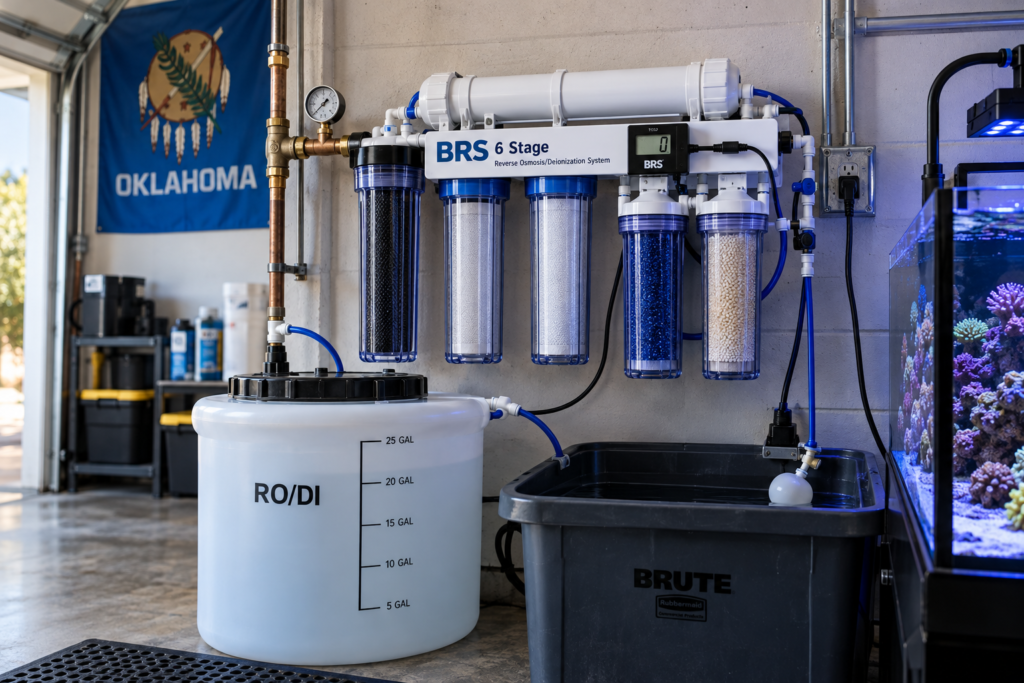
Every reef aquarium in Oklahoma City eventually runs on the same piece of equipment: an RO/DI system turning tap water into something a reef can actually live in. Most of how that equipment works is universal, the same principles apply whether you’re in Oklahoma City or anywhere else. But a handful of local realities change how hard your system has to work, and how you should think about keeping it maintained. This page covers the practical side: how to read your own system’s behavior instead of following a one-size-fits-all schedule.
Start here: rejection is a percentage, not a fixed number
This is the single most useful thing to understand about your RO membrane, and it’s the reason two reefkeepers with identical equipment can see completely different results.
An RO membrane doesn’t produce a fixed output TDS. It rejects a percentage of whatever’s in your feedwater, typically somewhere in the 95–98% range for a healthy membrane under normal conditions. That means the same membrane, performing exactly as designed, will produce noticeably different product water depending on what’s coming in. Higher feedwater TDS means higher product TDS, even from a membrane that’s working perfectly. We’ve seen reefkeepers replace a perfectly good membrane because their product TDS looked “too high” compared to someone else’s setup, when the real explanation was simply that their tap water going in was different.
The lesson: judge your membrane by its rejection percentage, not by comparing your product-water number directly to somebody else’s. If you don’t know your feed TDS, that’s the first number to check before you decide anything is wrong with your equipment.
Why Oklahoma City’s feedwater isn’t uniform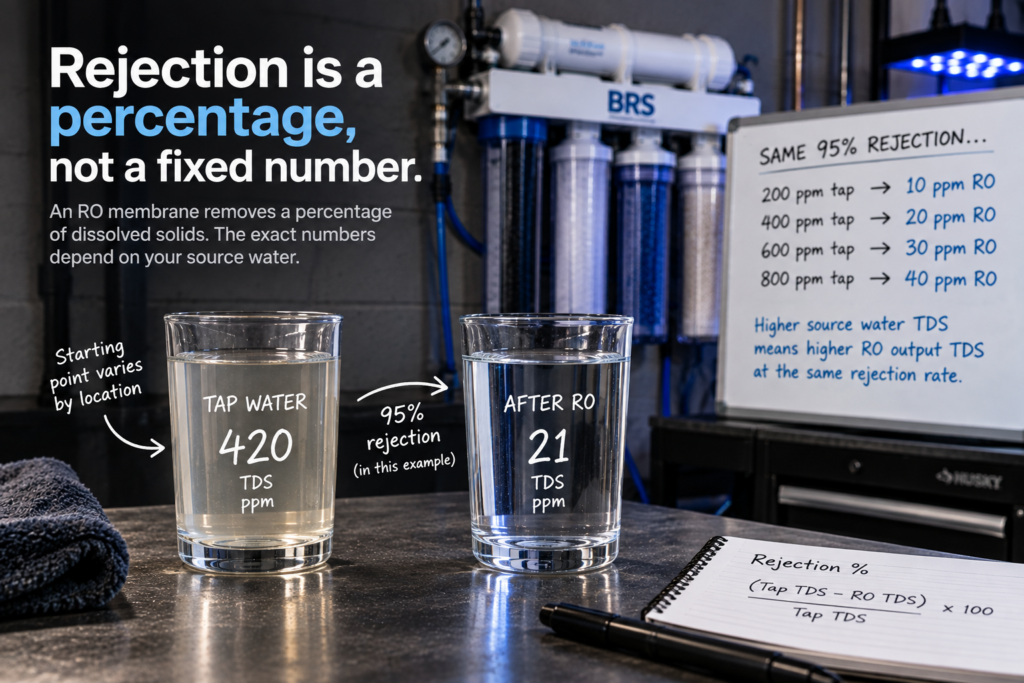
Chloramine is the reason carbon matters so much here
Oklahoma City’s chloramine disinfection is the biggest single factor shaping how an RO/DI system should be configured in this market. Chloramine needs real contact time with catalytic carbon to break down properly before it reaches your membrane, and it isn’t reliably caught anywhere downstream if your carbon stage falls behind. We’ve covered this in depth separately, it’s worth reading if you haven’t.
Chloramine and your reef aquarium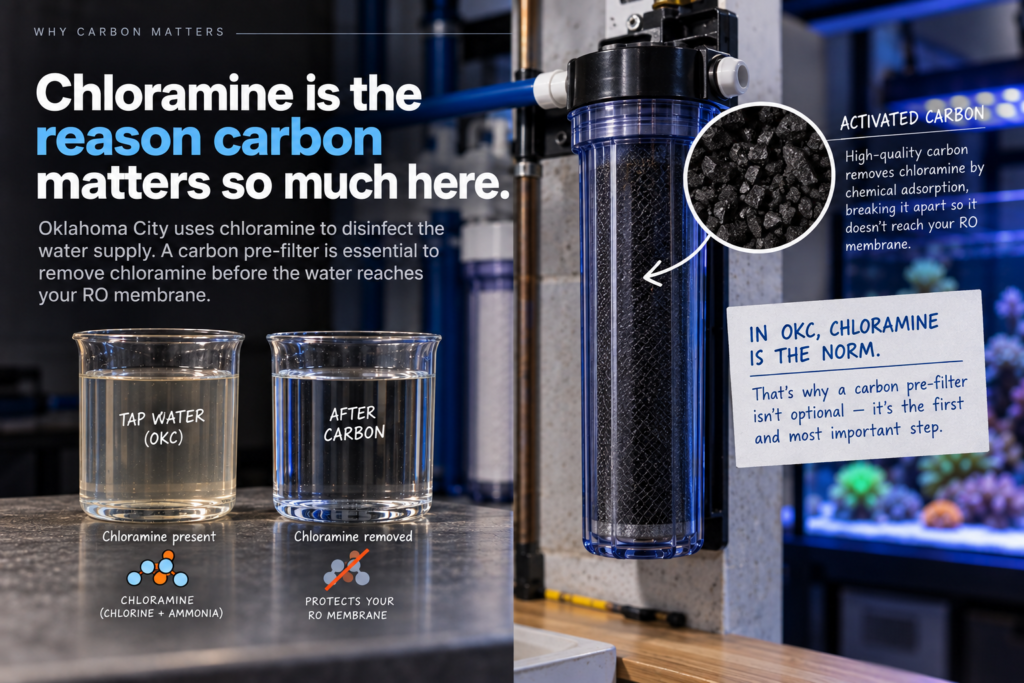
Why DI resin life varies more than people expect
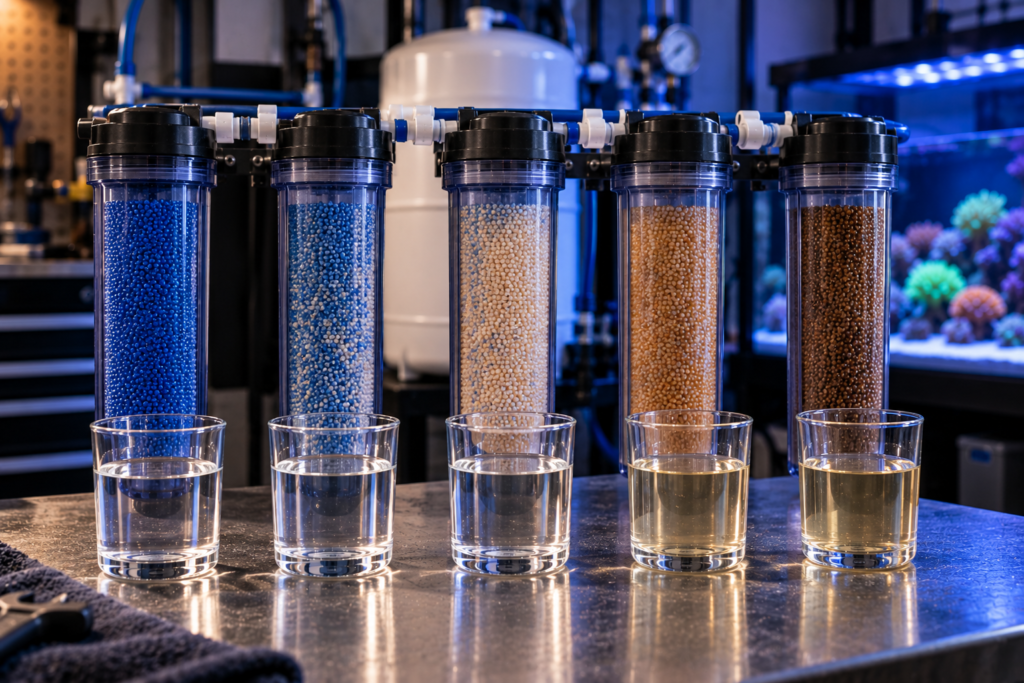
Deionization resin exhausts based on the total ionic load passing through it, everything from hardness minerals to sodium to whatever else is dissolved in your particular water. Because Oklahoma City’s feedwater isn’t uniform citywide, and because several surrounding cities in the metro draw from entirely different sources, DI resin life is genuinely one of the least predictable numbers in reefkeeping here. Two setups running the same volume of water, on the same schedule, can exhaust their resin at noticeably different rates simply because their feedwater carries a different mineral load.
This is also why running softened tap water into an RO/DI feed is worth thinking through rather than doing automatically. A water softener trades hardness minerals for sodium, it doesn’t reduce the total dissolved load, it changes its character. That can protect your membrane from scale, which is a real benefit, but it can also mean your DI resin exhausts differently than it would on unsoftened feed. Neither approach is universally “correct.” It depends on your specific water and your setup.
The practical response isn’t to memorize a resin lifespan, it’s to check your product-water TDS regularly and let the number tell you when resin needs attention, rather than assuming a fixed interval will hold from one season to the next.
Pressure and temperature both affect production (and both change here)
Two variables people underestimate: feed pressure and feed temperature. RO membranes are rated at a standard pressure and temperature, and real-world conditions rarely match the rating exactly. Lower household water pressure means slower production and, in some cases, worse rejection. Colder feedwater, which is a real factor if your RO/DI unit lives in an unconditioned garage through an Oklahoma City winter, measurably slows production, sometimes enough that a unit that filled a container in twenty minutes in July takes noticeably longer in January.
If your production seems to have quietly slowed down and nothing else has changed, check where the unit is physically located and what season it is before assuming a component has failed.
Where OKC reefkeepers actually put their equipment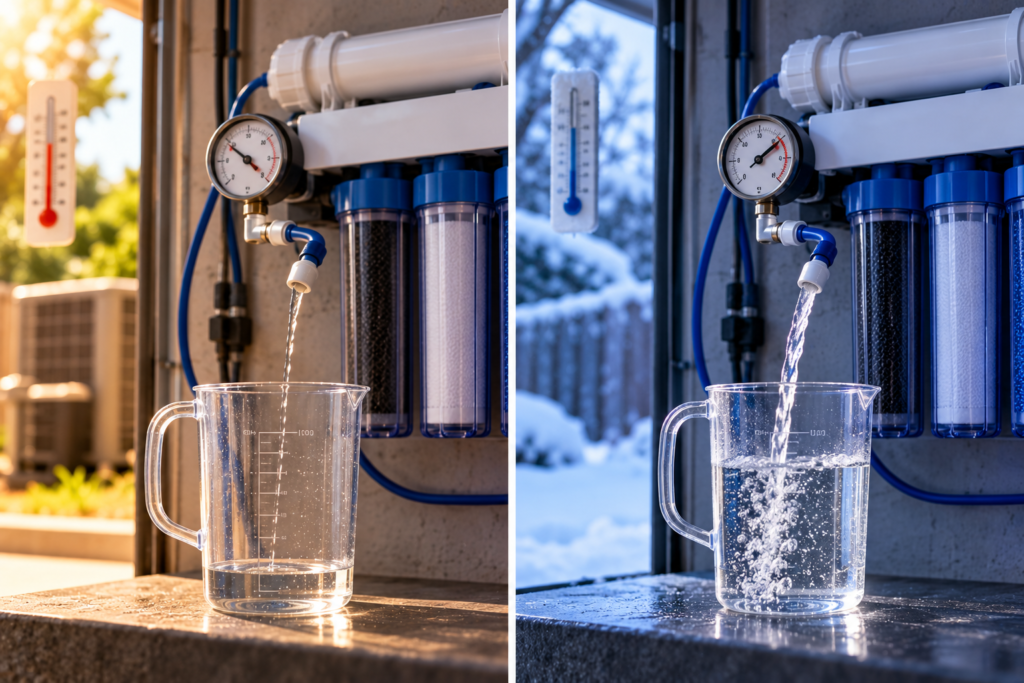
Local water conditions can shift…and that’s when to pay attention
Municipal water isn’t static. Treatment adjustments, seasonal source changes, and occasional short-term events, like a temporary discoloration issue traced to naturally occurring minerals, can all change what’s coming out of your tap, sometimes with no announcement at all. If your RO/DI’s performance suddenly shifts and you haven’t changed anything on your end, it’s worth checking your feedwater before assuming your equipment is failing. This is a genuinely local consideration: reefkeepers in cities with a single, highly stable water source rarely have to think about it, but it’s a real factor in the Oklahoma City metro.
How water conditions compare across the metroA practical framework instead of a fixed schedule
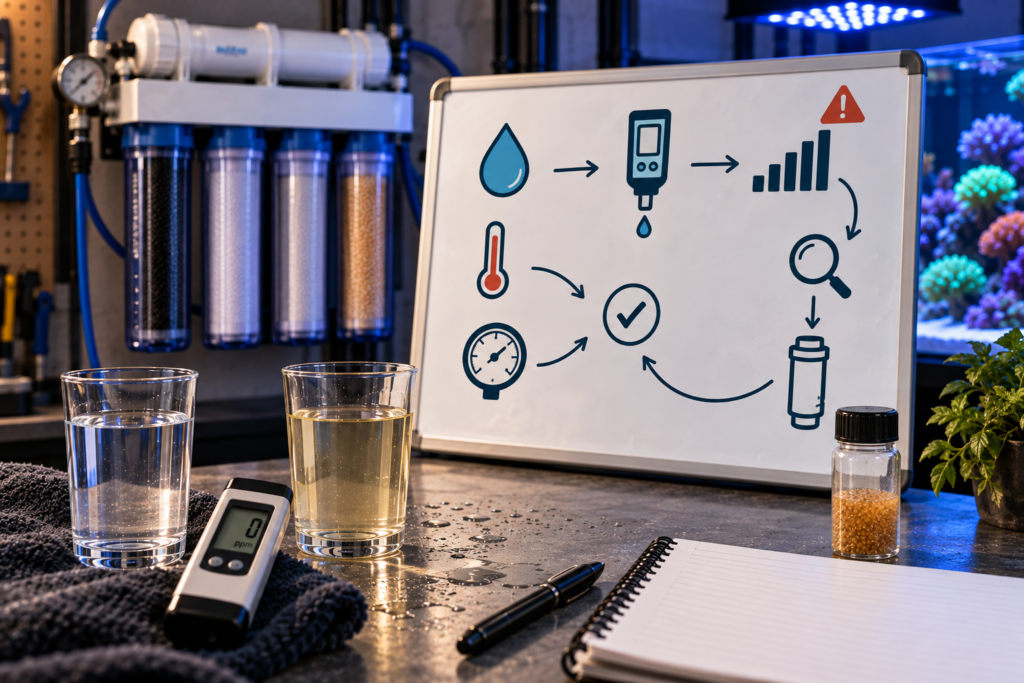
We’re not going to give you a universal “change your filters every X months” rule, because it wouldn’t be honest, your correct interval depends on your feedwater, your flow rate, your carbon volume, and how much water you actually make. Instead, here’s how to know when something needs attention:
- Check feed TDS occasionally, not just product TDS. A rising feed number explains a rising product number without anything being “wrong.”
- Watch production rate over time. A steady slowdown, especially seasonal, usually points to pressure, temperature, or membrane fouling, not carbon.
- Track product TDS as a trend, not a single reading. A slow, steady rise usually means DI resin is approaching exhaustion. A sudden jump is worth investigating right away.
- Don’t rely on TDS alone for chloramine. As covered on our chloramine page, a good TDS reading doesn’t confirm your carbon is still doing its job.
- When something changes with no obvious cause on your end, check whether anything changed with your water supply first.
That framework will serve you better than any calendar-based rule, because it’s built around what your specific system is actually telling you.
The bottom line
An RO/DI system in Oklahoma City works the same way it does anywhere, the physics doesn’t change. What changes is how much your feedwater varies, how much your carbon stage has to handle, and how much attention your system needs relative to what a generic national guide would tell you. Pay attention to trends instead of chasing a fixed schedule, and you’ll catch problems well before they reach your tank.
If you’d rather have your system checked, sized correctly, and put on a schedule that matches your actual water and usage, that’s exactly what ongoing reef maintenance is built to handle.
Reef aquarium maintenance in Oklahoma City Request a reef assessment
Sources
- City of Oklahoma City, Water Utilities Trust Drinking Water Quality Report and "About Your Tap Water" — supports general feedwater variability context, referenced from the tap water page.
- City of Oklahoma City News release on Draper Water Treatment Plant service area discoloration, August 24, 2026 — supports the example of a short-term municipal water event affecting feedwater without changing RO/DI equipment.
- General RO membrane operating principles (rejection percentage, pressure and temperature dependence) reflect standard, widely published reverse-osmosis engineering fundamentals consistent across manufacturer technical documentation.